When Soft 17 Rules Collide With Cashback Offers: The Calculations Players Overlook
Jonas Lorenz · Jul 13, 2026
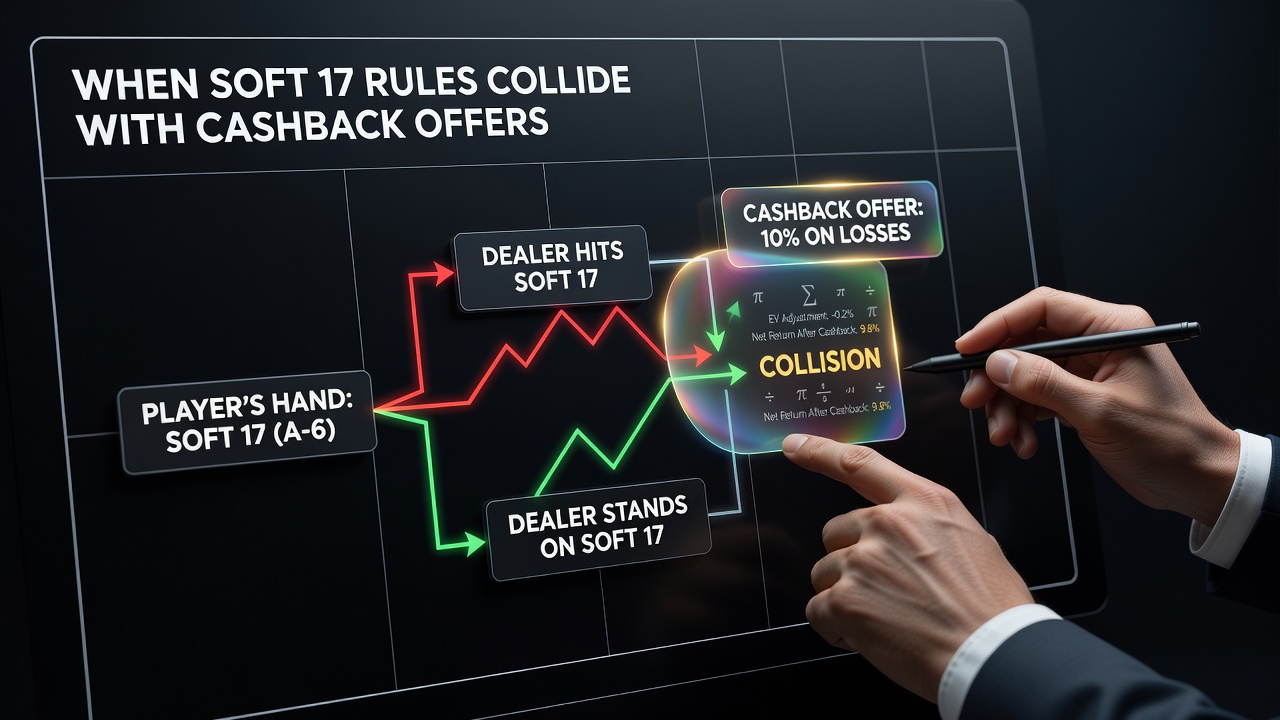
When Soft 17 Rules Collide With Cashback Offers: The Calculations Players Overlook
Blackjack rules vary widely across casinos and jurisdictions, yet few players adjust their approach when dealer actions on soft 17 intersect with cashback promotions that return a percentage of losses. Data from the Nevada Gaming Control Board shows house edges shift measurably between games where dealers hit soft 17 and those where they stand, while cashback structures add another layer that alters long-term expected value in ways basic strategy charts rarely address.
Soft 17 Rules and Their Direct Impact on House Edge
Dealers who hit on soft 17 increase the house edge by roughly 0.2 percent compared with standing rules, according to compiled gaming reports from multiple U.S. states. This difference arises because the dealer gains additional opportunities to improve borderline hands without busting immediately. Players who continue using the same decisions against every upcard overlook how the altered dealer totals change the value of standing, hitting, or doubling in specific situations.
Research from academic studies on probability modeling confirms that basic strategy adjustments become necessary once the dealer hits soft 17, particularly against dealer upcards of 9, 10, or ace. The frequency of these hands means the cumulative effect compounds over thousands of decisions rather than remaining negligible in short sessions.
Cashback Structures and How They Modify Effective Return
Cashback offers typically refund between 0.5 and 1.5 percent of tracked losses over a defined period, creating a rebate that reduces the net house edge. Yet this reduction applies only after losses occur and only on the portion of play that qualifies under the promotion's terms. Observers note that many programs exclude certain bet types or cap the rebate amount, which limits the offset when players chase larger wagers to maximize the return.
Figures from industry analyses indicate that a 1 percent cashback lowers the effective house edge by approximately that amount only when applied uniformly to all losses. When combined with rule variations such as soft 17 hitting, the interaction produces a narrower margin that still favors the house unless strategy adapts to both factors simultaneously.
Where the Two Elements Interact in Overlooked Ways
The collision appears most clearly in expected value calculations for hands where players must decide whether to double or surrender. Cashback reduces the cost of a loss, yet the higher frequency of dealer improvement under hit-on-soft-17 rules increases the chance that doubled hands lose more often. Those who apply standard strategy without recalculating for the rebate miss the point where surrender becomes less attractive because part of the loss returns via cashback.
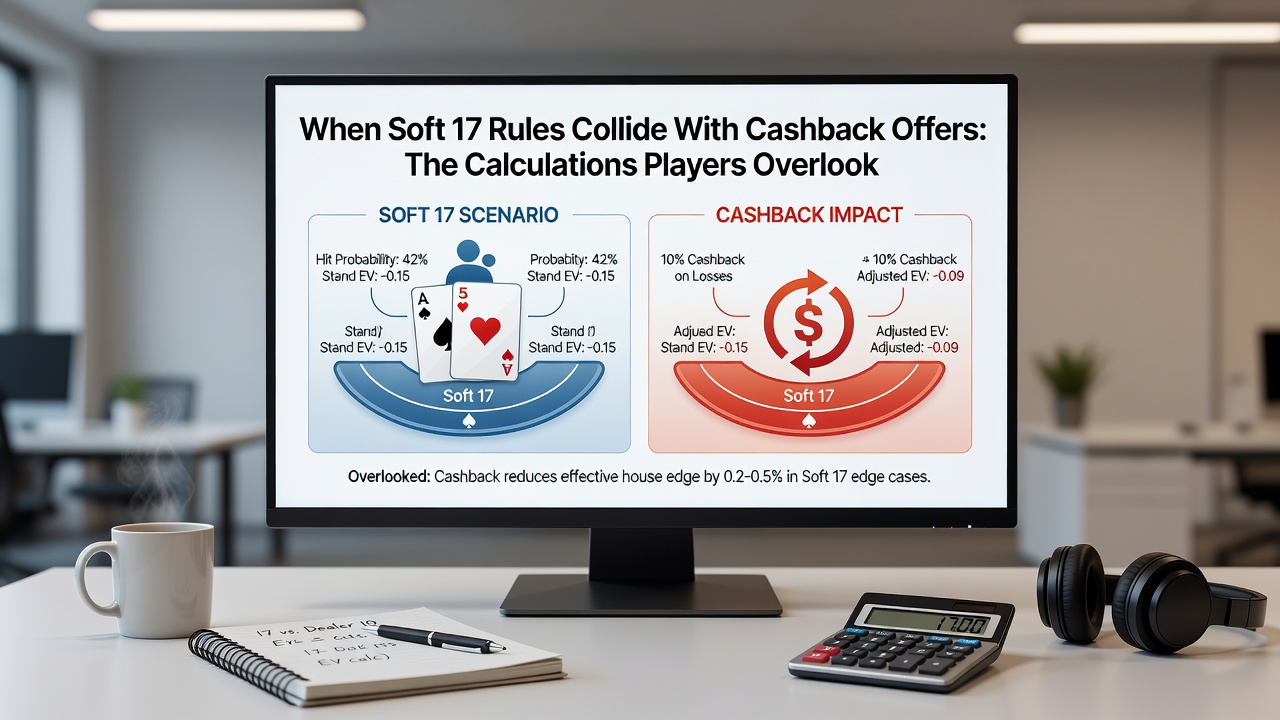
One study published through a Canadian research institute examined multi-hand sessions under varying rules and rebate levels, revealing that optimal doubling thresholds shift by small but consistent margins when cashback exceeds 0.75 percent. The same analysis found that players who ignored these shifts left measurable value unclaimed over extended play periods.
July 2026 regulatory updates in several North American markets introduced new disclosure requirements for promotional terms, requiring operators to list how rebates interact with specific rule sets. These changes followed earlier reports showing widespread player confusion over combined mechanics, prompting clearer documentation without altering the underlying mathematics.
Recalculating Decisions Under Combined Conditions
Expected value formulas must incorporate both the rule set and the rebate percentage before determining the correct action. For instance, standing on certain soft totals against a dealer 6 may yield a different result once the cashback refund offsets part of potential losses that occur when the dealer hits through the soft 17. Researchers who modeled these scenarios found that roughly one in twelve borderline decisions flips when both elements operate together.
Players who track results across multiple sessions can identify patterns where the cashback amount alters the realized return more than the raw rule difference alone would predict. Data from European gaming associations shows similar patterns emerging in markets where cashback promotions gained popularity alongside rule standardization efforts.
Conclusion
Soft 17 rules and cashback offers each modify blackjack outcomes in measurable ways, yet their combined influence on strategy remains under-examined by most participants. Accurate adjustments require integrating house-edge shifts from dealer actions with the timing and caps of rebate programs, producing decision thresholds that differ from either factor considered separately. Updated modeling from regulatory and academic sources continues to quantify these interactions as operators refine promotional structures across jurisdictions.