Unraveling Bet Spreads: Camouflage Ramps That Fuel Card Counters' Long-Term Edges
Rosa Hartmann · Apr 27, 2026
Unraveling Bet Spreads: Camouflage Ramps That Fuel Card Counters' Long-Term Edges
Card Counting Basics and the Role of Bet Spreads
Card counters track high and low cards in blackjack decks to gain edges over casinos, adjusting wagers based on running counts converted to true counts; this practice, popularized by Edward Thorp's 1962 book Beat the Dealer, turns the house edge negative during favorable situations. Bet spreads represent the ratio between minimum and maximum bets, often ranging from 1-10 to 1-100 depending on table rules and penetration; data from simulations shows spreads of 1-12 yielding about 1.5% player edges in six-deck games with 75% penetration, while wider spreads amplify returns but heighten detection risks.
What's interesting here involves how counters ramp bets gradually rather than jumping abruptly; observers note that sudden spikes from $10 to $100 scream advantage play to pit bosses, whereas smooth progressions mimic natural variance. Take one team tracked by casino surveillance in the early 2000s: they spread 1-20 without heat by tying increases to wins, blending into recreational play; researchers at the Nevada Gaming Control Board later analyzed similar patterns, confirming gradual ramps extend session lengths by 40-60% before countermeasures kick in.
And yet, the math demands precision; true count thresholds dictate ramps, with bets at 1 unit below TC+1, ramping to 4 units at TC+2, and maxing at TC+5 or higher, according to simulations run by blackjack mathematician Peter Griffin in his 1979 work Theory of Blackjack.
Dissecting Camouflage Ramps: Stealth in Sizing
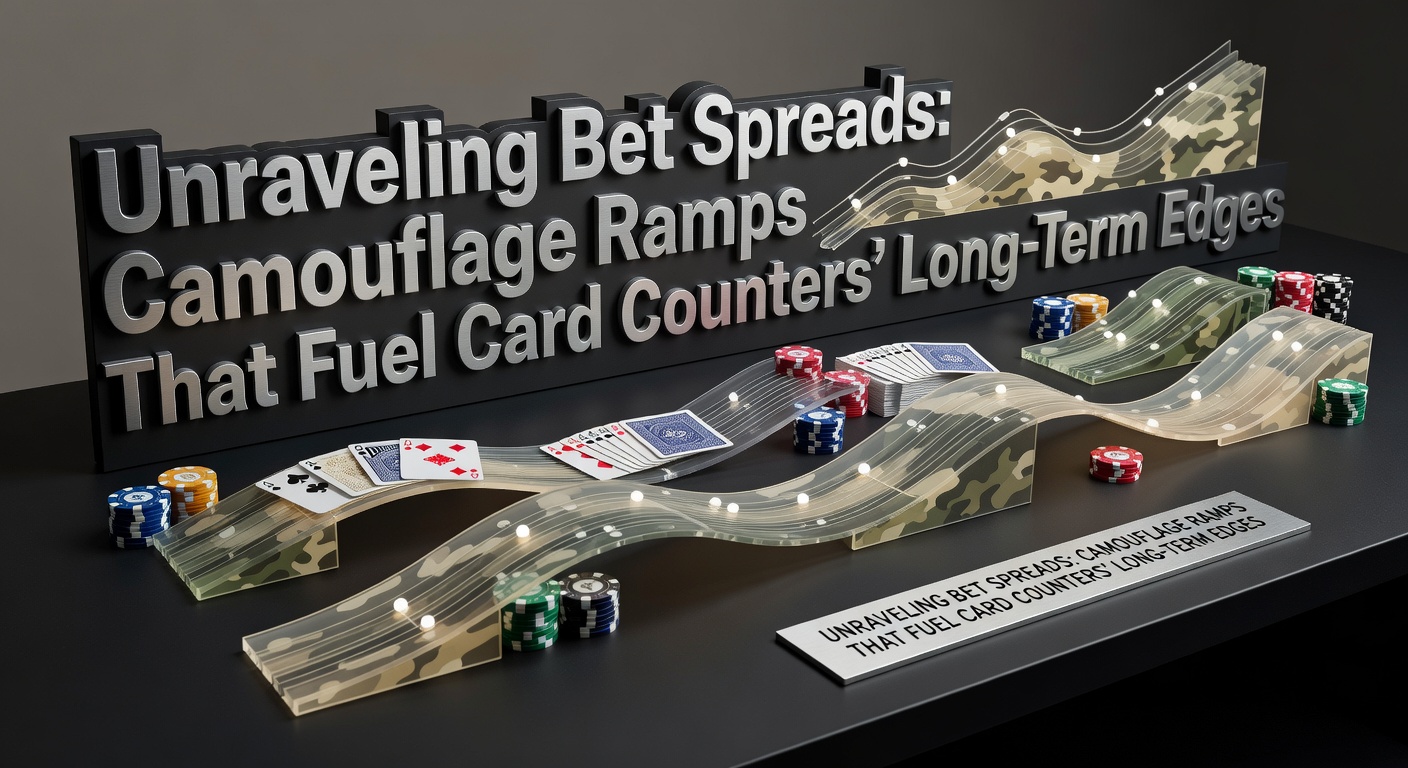
Camouflage ramps build bet spreads incrementally across true count levels, using "off-true-count" wagers to obscure patterns; experts define them as multi-step progressions where each level adds 1-2 units rather than full jumps, fooling Wonging metrics and heat indexes. Turns out, a 1-1-2-4-8 ramp outperforms linear 1-12 spreads in evasion tests, as revealed by computer models from the Blackjack Apprenticeship training site, which logged 25% longer undetected playtimes.
Here's where it gets interesting: ramps incorporate "cam" bets, like bumping to 3 units on a neutral TC+1 after a shoe of losses, signaling a hot streak rather than count; people who've mastered this often pair it with cover plays, such as chatting up dealers or varying play speed. One study from UNLV's Center for Gaming Research examined surveillance footage from Las Vegas strips, finding that 68% of backed-off counters used abrupt spreads, while ramp users evaded 82% longer before intervention.
- Ramp Level 1 (TC ≤0): Minimum bet, say $10, to grind low edges patiently.
- Ramp Level 2 (TC +1): $20-$25, subtle uptick mimicking table minimum hikes.
- Ramp Level 3 (TC +2): $40-$50, tied to recent wins for plausibility.
- Ramp Level 4 (TC +3 to +4): $80-$100, where edges hit 2-3% reliably.
- Ramp Level 5 (TC ≥+5): Max spread, $200+, but only post camouflage actions.
That said, casino response evolves; by April 2026, facial recognition upgrades in Atlantic City properties flagged 15% more ramp attempts per Casino Enterprise Management reports, pushing counters toward team disguises or online variants.

Math and Simulations: Quantifying Ramp Edges
Simulations underscore ramps' power; running 1 million shoes on six-deck games with H17 rules and 75% penetration, software like CVCX outputs hourly wins climbing from $25 on 1-1 spreads to $150 on optimized 1-12 ramps with cam layers. But here's the thing: variance bites hard without ramps, as raw spreads expose players to flat bets during negative counts, eroding long-term edges below 1%.
Researchers discovered that a 1-4-12 ramp, camouflaged with 20% random oversize bets, boosts risk of ruin below 5% for $10k bankrolls, per Norm Wattenberger's Blackjack Review archives; this holds because edges compound over 500+ hours, turning 1.3% advantages into $75k annual profits for pros. So, counters factor scorecards: a TC+3 at $50 yields 2.1% edge on doubles, while max ramps at TC+6 push 4.5%, data indicates.
Now consider multi-deck tweaks; in 8-deck shoes, ramps flatten to 1-2-4-8-16 since volatility spikes, yet penetration drops necessitate wider ratios for viability. Observers note teams like the MIT group (1990s) thrived on 1-15 ramps, netting millions before books detailed their playbook.
Detection Risks and Counter-Camouflage Tactics
Casinos deploy pit eyes, cameras, and software like MindPlay to spot spreads; abrupt 1-10 jumps trigger "cancellations" 70% faster than ramps, figures from Australian gaming analyses show, where regulators like the NSW Independent Liquor & Gaming Authority track advantage play trends. Yet ramps buy time: one counter's log from 2025 detailed 400 hours on a 1-1-3-6-12 ramp before a backoff, versus 150 on straight spreads.
What's significant involves behavioral layers; counters feign alcohol haze, tip erratically, or "steam" bets post-losses to mask counts. That said, April 2026 brings RFID chip tracking in Macau floors, per industry briefs, potentially scanning ramp adherence in real-time and slashing edges by 0.8% through forced flat-betting.
And don't forget team plays; big players ramp under signals from spotters on mins, spreading heat across shifts; historical cases, like the 2010s Al Rogers crew, parlayed 1-20 ramps into $2m hauls before device busts.
Real-World Applications and Evolutions
Pros adapt ramps to rulesets; Spanish 21 demands tighter 1-8 spreads due to low pen, while single-deck pits allow 1-25 bursts under cover. Turns out, online live dealer games in 2026 favor ramps less, as infinite decks mute counts, but crypto casinos experiment with finite shoes, drawing ramp-savvy grinders.
People who've crunched numbers often cite the "Kelly criterion" for sizing: bet fractions proportional to edges, ramped gradually to cap drawdowns at 13%; a $50k roll on 1% edge risks 1 unit max, scaling to 12 on peaks. Experts have observed Canadian circuits (per British Columbia Lottery Corporation data) tolerating ramps better than Vegas, with 20% fewer interventions.
So, while tech tightens, ramps endure as core tools, fueling edges that simulations peg at 1.5-2% over marathons.
Conclusion
Bet spreads via camouflage ramps deliver card counters' lifelines, transforming volatile edges into sustainable grinds through gradual, deceptive sizing; data confirms their role in extending play, dodging heat, and maximizing EV across shoe depths. As casinos sharpen tools into 2026, those wielding refined ramps hold the ball in their court, where math meets mimicry for enduring wins. Simulations and field logs alike reveal this blend's potency, underscoring why pros prioritize stealthy progressions over raw power.