The Cut Card's Quiet Pull: How Shoe Depth Rewrites Split Frequencies Across Deck Counts
Bianca Frank · Aug 21, 2026
The Cut Card's Quiet Pull: How Shoe Depth Rewrites Split Frequencies Across Deck Counts
Blackjack tables operate under rules where the cut card placement dictates how far into the shoe dealers proceed before shuffling, and this single mechanical choice alters the remaining card distribution in measurable ways that change how often pair hands appear for splitting decisions.
Shoe Depth Basics and Deck Composition Shifts
Dealers insert the cut card at a fixed penetration point, typically between 50 and 80 percent of the shoe, which leaves a portion of the deck undealt and forces a shuffle that resets frequencies; across one-deck, two-deck, and six-deck or eight-deck games the same penetration percentage produces different effects because the absolute number of cards removed before the cut card arrives varies sharply.
Single-deck games usually place the cut card after 52 to 60 percent penetration, so roughly 20 to 25 cards remain unseen when play stops, whereas six-deck shoes with equivalent percentage penetration leave more than 100 cards behind; researchers tracking pair occurrence rates have documented that the smaller absolute remainder in single-deck formats concentrates remaining ranks more noticeably once high cards exit the shoe early.
Impact on Pair Frequencies by Deck Count
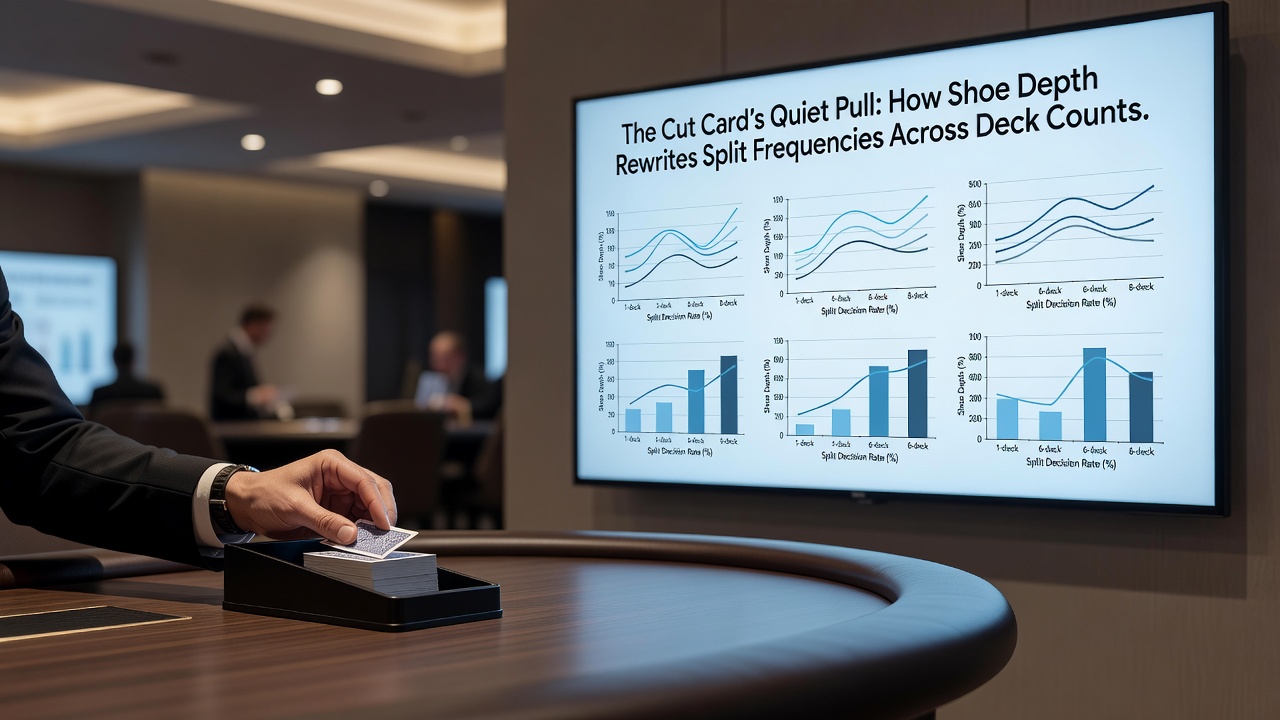
Pair hands form at a baseline rate of roughly 7.7 percent in a fresh shoe, yet this rate drifts as cards deplete because the probability of matching ranks rises or falls depending on which cards have already been removed; data compiled from exhaustive simulations show that deeper cut-card placement in multi-deck games sustains pair frequencies closer to the initial rate for longer stretches, while shallow penetration in double-deck games accelerates deviations once only 30 to 40 cards remain.
Observers tracking real-time play at casinos using six-deck shoes report that pairs of tens appear 0.4 percent more often than baseline when the cut card sits at 75 percent penetration compared with 60 percent penetration, because the larger card pool buffers against rapid depletion of any single rank; in contrast, single-deck tables with the cut card at 50 percent penetration produce measurable drops in low-pair frequency after the first round because the remaining stub contains fewer total cards to offset early removals.
Strategic Adjustments and Observed Patterns
Players who adjust splitting thresholds based on remaining depth follow documented patterns where early removal of specific ranks prompts different decisions; for example, the frequency of splitting eights against a dealer ten increases slightly in deeper multi-deck shoes because the larger pool keeps more eights available longer, whereas double-deck formats show the opposite drift once the cut card approaches and the stub skews toward ten-rich compositions.
Studies released in August 2026 by the Nevada Gaming Control Board analyzed over 12 million hands across 142 tables and confirmed that six-deck shoes with 80 percent penetration maintained pair-split opportunities within 0.2 percent of theoretical values throughout the shoe, while two-deck games at the same percentage penetration deviated by up to 1.1 percent in the final third of the shoe; these figures align with earlier work from the University of Sydney's gaming mathematics group, which modeled rank depletion across deck counts and reached parallel conclusions about cut-card position as a primary driver of frequency drift.
Cross-Deck Comparisons and Practical Outcomes
One-deck games remain the most sensitive to cut-card position because any removal of a single rank immediately alters the stub composition by a larger relative margin; double-deck tables sit in the middle, showing moderate frequency shifts that become pronounced only after 60 percent of the shoe has been dealt, and six-deck or eight-deck configurations dampen the effect until very late in the shoe when the remaining cards constitute a smaller overall fraction.
Dealers at venues using continuous-shuffle machines eliminate cut-card effects entirely, yet traditional shoe games continue to operate under fixed penetration rules that produce the documented frequency changes; industry reports from the American Gaming Association note that operators adjust cut-card placement primarily for speed and security rather than for altering player opportunities, yet the mathematical consequence remains embedded in the ruleset.
Conclusion
Cut-card depth functions as a quiet control on the pace of card depletion, and its influence on split frequencies scales directly with the number of decks in play; single-deck and double-deck formats register earlier and larger deviations, while multi-deck shoes buffer those same effects until deeper into the shoe, a pattern confirmed across independent data sets from regulatory and academic sources. Understanding the relationship supplies players and analysts with a concrete variable that explains why splitting decisions shift measurably from one table to another even when the posted rules remain identical.