Inside Blackjack's Core Mechanics: How Hand Composition Influences Strategic Choices Over Extended Sessions
David Frank · Aug 7, 2026
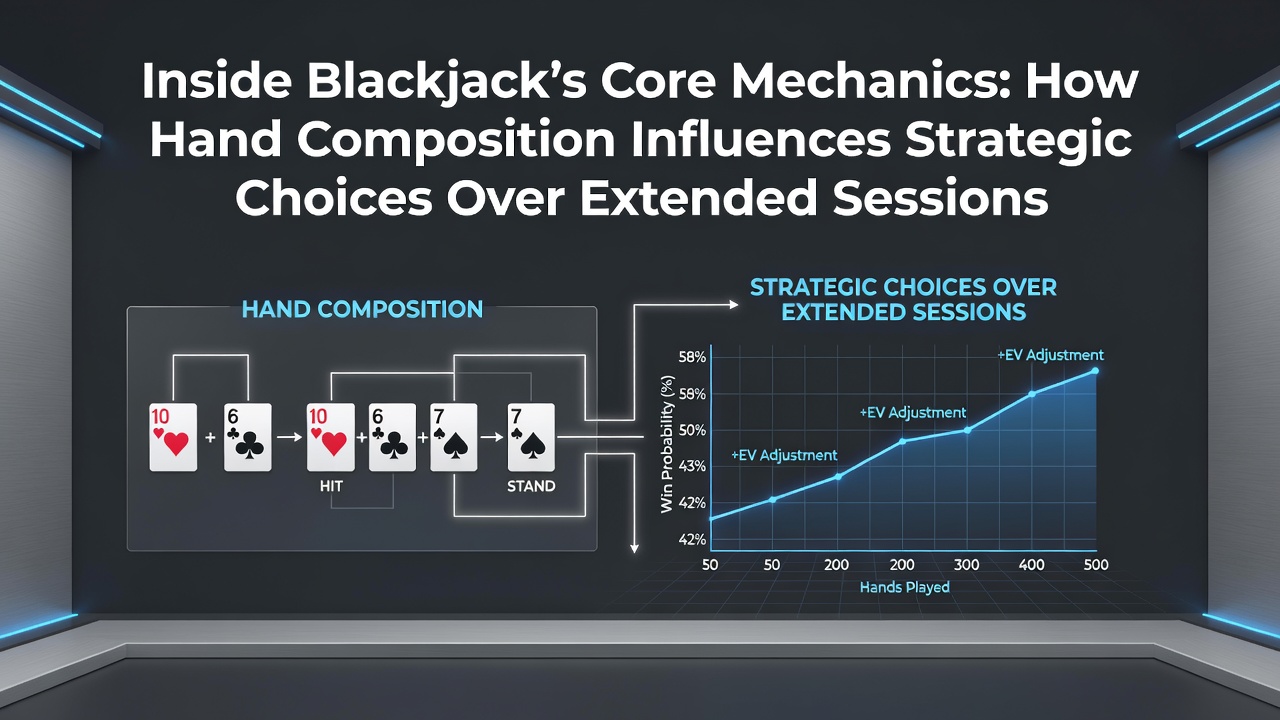
Inside Blackjack's Core Mechanics: How Hand Composition Influences Strategic Choices Over Extended Sessions
Blackjack hand composition determines every strategic choice at the table because the numerical makeup of a player's cards interacts directly with the dealer's upcard and the remaining deck structure. Researchers at institutions such as the University of Nevada Reno have documented how totals built from different card combinations produce identical point values yet trigger distinct decisions when aces or pairs appear. Data from the Nevada Gaming Control Board shows that multi-deck games in regulated markets maintain consistent rule sets through August 2026, which means composition effects remain stable across thousands of hands played in a single session.
Hard Totals and Their Fixed Decision Points
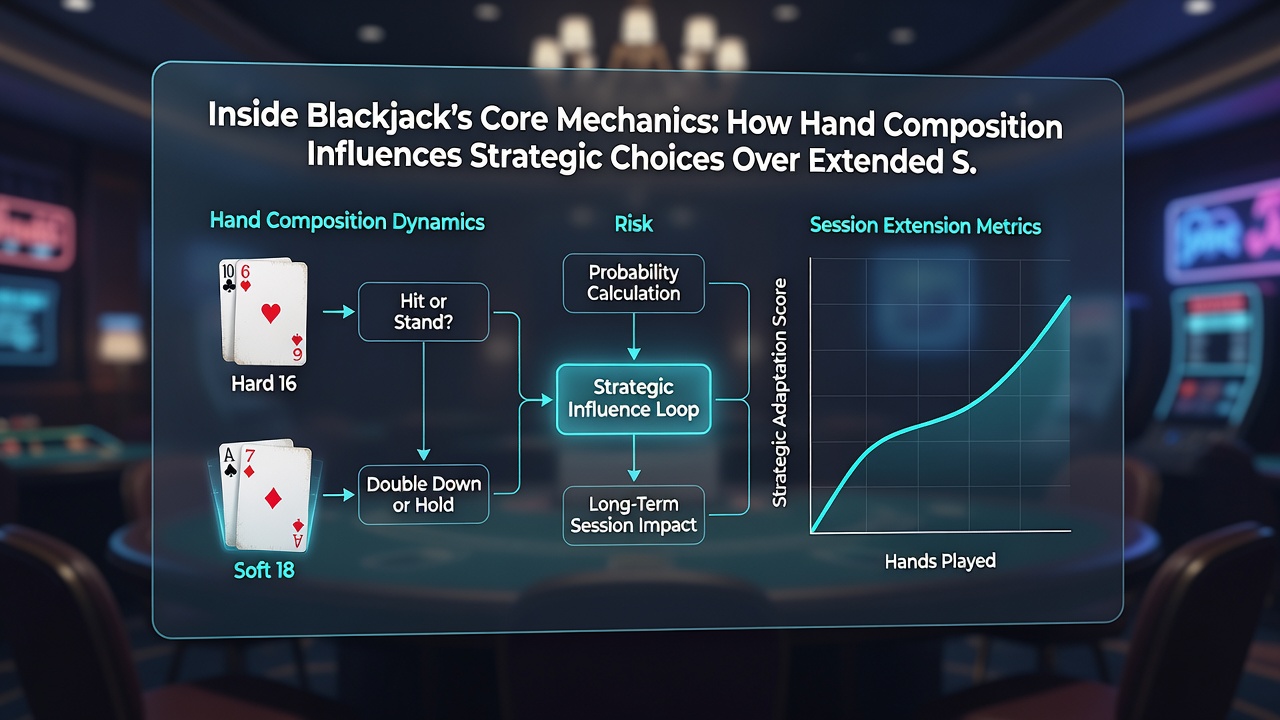
Hard totals without an ace force straightforward calculations because no secondary valuation exists to alter the count. A player holding 16 against a dealer ten must hit under basic strategy charts derived from exhaustive combinatorial analysis, while the same total against a dealer six prompts a stand because the probability distribution favors the dealer busting. Observers note that these choices repeat thousands of times during extended sessions, and the cumulative effect compounds because each decision carries a measurable expected value shift documented in probability tables. Hand composition here matters less for the total itself and more for whether the cards allow doubling or splitting opportunities later in the round.
Soft Hands and Variable Valuation Effects
Soft hands introduce an ace that can count as one or eleven, which expands the decision tree at every dealer upcard. A soft eighteen composed of ace-seven against a dealer nine requires a hit according to standard charts, whereas the same total against a dealer three calls for doubling because the ace provides a safety buffer that raises the overall expectation. Studies compiled by the American Gaming Association indicate that soft hand frequency increases in games with higher ace retention rates, and players who follow composition-specific rules maintain lower variance across sessions lasting several hours. The presence of the ace changes the mathematical weight of each subsequent card drawn, which is why charts list separate columns for soft totals rather than grouping them with hard equivalents.
Pair Splitting and Composition Multipliers
Pairs represent the clearest case where hand composition overrides simple total value because splitting creates two independent hands with fresh decision opportunities. A pair of eights against a dealer ten must split under basic strategy because teh expected loss on the unsplit sixteen exceeds the combined losses on two separate hands starting at eight each. Conversely, a pair of tens never splits because the twenty already sits near the maximum possible value and any split reduces overall expectation. Figures released by the Australian Gambling Research Centre reveal that split frequency in eight-deck shoe games averages 3.2 percent of rounds, and the long-term return deviation from correct pair decisions accumulates at measurable rates when sessions exceed five hundred hands.
Deck Depletion and Composition Feedback Loops
As cards leave the shoe, the remaining composition shifts the relative value of every player hand type. A depletion of low cards increases the frequency of high-total hard hands while simultaneously raising the proportion of soft hands that reach twenty. Those who track these shifts through observation alone notice that certain dealer upcards appear more often with particular remaining card mixes, which alters the optimal response to borderline totals such as hard fifteen or soft seventeen. Research papers from Canadian university gaming laboratories confirm that these feedback effects become statistically detectable after approximately two hundred hands in a single shoe, although the magnitude stays small enough that basic strategy adjustments remain unnecessary for most participants.
Session Length and Decision Consistency
Extended sessions amplify the impact of each composition-driven choice because small expected-value differences multiply across repeated rounds. A player who deviates from composition rules on soft hands, for instance, experiences a documented return reduction that grows linearly with the number of hands played. Regulatory data collected across multiple jurisdictions through mid-2026 shows average session lengths in land-based venues ranging from ninety minutes to four hours, during which hand composition patterns repeat in predictable cycles tied to shuffle points and penetration levels. Consistency in applying the correct response to each unique combination therefore becomes the primary mechanism that separates long-term outcomes.
Conclusion
Hand composition functions as the central variable that translates raw card values into actionable strategy across every round of blackjack. The interaction between total, ace presence, pair status, and dealer upcard creates a decision matrix that remains fixed under standard rules yet produces different expectations depending on the exact cards held. Over extended sessions these individual choices accumulate according to established probability models, and adherence to composition-specific guidelines preserves the mathematical baseline established through exhaustive simulation. Data from multiple regulatory and academic sources continues to affirm that the structure of each hand, rather than external factors alone, dictates the strategic path forward.