From One Deck to Eight: How Blackjack Strategy Evolves with the Shoe
David Frank · Mar 30, 2026
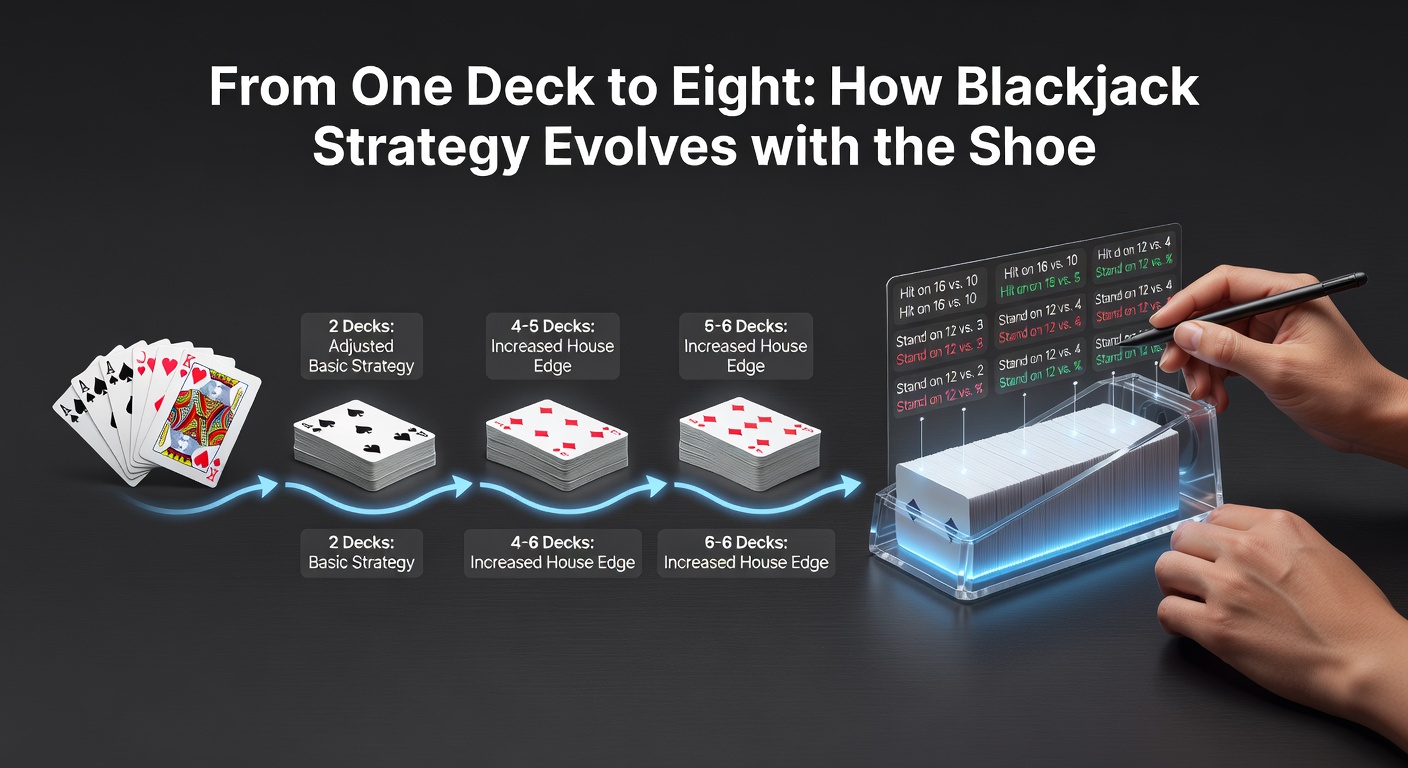
From One Deck to Eight: How Blackjack Strategy Evolves with the Shoe
Blackjack players encounter everything from single-deck games to massive eight-deck shoes, and strategy shifts dramatically across that spectrum because more decks alter probabilities, house edges, and optimal plays; experts have long observed how these changes demand precise adjustments to stay ahead.
The Single-Deck Foundation: Where Strategy Shines Brightest
Single-deck blackjack sets the baseline for strategy since fewer cards mean higher volatility but better odds for skilled players; data from early casino analyses shows house edges dipping as low as 0.15% with perfect play, far below multi-deck norms. Players hit more aggressively on soft hands, double down frequently against weak dealer upcards like 4 through 6, and split pairs liberally—take 8-8 against a dealer 6, for instance, where the math favors aggressive action because card removal impacts outcomes sharply.
But here's the thing: casinos limit single-deck games to low stakes or specific rules like no doubling after splits, which keeps the edge tight; observers note that in places like downtown Las Vegas, these games persist as of March 2026, drawing strategy purists who memorize the nuanced chart for this format. Research from Wizard of Odds simulations confirms splitting 10s occasionally against a dealer 5 or 6, a play vanishing in shoe games, while standing on 12 against a 2 becomes standard because tens lurk less densely.
What's interesting is how penetration—dealing deep into the deck—amplifies advantages here; with full penetration, basic strategy alone crushes the house, but casinos counter by shuffling early, forcing players to adapt or walk.
Transition to Multi-Deck: Doubling and Quadrupling Complexity
As decks climb to two, four, or six, the game morphs because card frequencies even out, reducing the power of basic strategy tweaks; figures reveal house edges creeping to 0.32% for two decks under standard rules (dealer stands on soft 17, double after split allowed), prompting shifts like hitting 11 against an ace instead of doubling in some variants. Players who've crunched the numbers find insurance becomes rarer past one deck since true counts rarely justify it, and pair splitting tightens—9-9 splits only against 2 through 9, not 7 as in single-deck.
And yet, four-deck shoes introduce subtle deviations; studies indicate standing on hard 16 against a dealer 10 in deeper penetrations, but hitting in shallow ones, while soft 18 doubles against 6 more often because intermediate cards dilute bust risks. Turns out, the rubber meets the road in rule variations too—late surrender appears more in multi-deck, boosting EV by 0.08% according to simulations, so savvy players hunt tables with that option.
Now, consider a case where a player faces 12 versus dealer 3 in a two-deck game; strategy dictates hitting, unlike the single-deck stand, because extra decks flood the unseen cards with tens, tipping the scales.
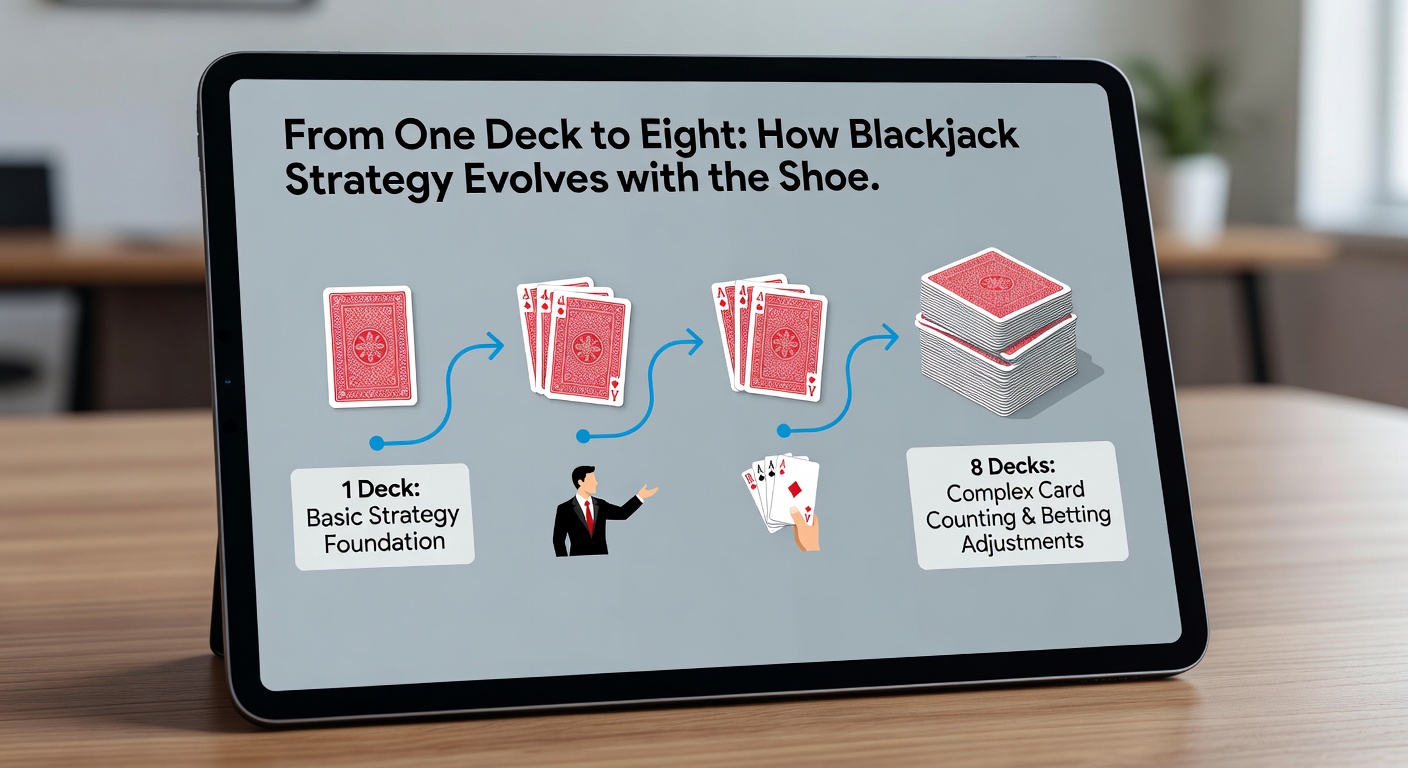
The Eight-Deck Shoe: Endurance Test for Modern Strategy
Eight-deck shoes dominate Strip casinos today, with Nevada Gaming Control Board reports from early 2026 showing over 85% of tables using them amid high-volume play; house edges settle around 0.50%-0.65% depending on rules, so strategy simplifies to conserve mental energy during long shoes—hit 16 against 10 universally, stand on 12 against 4-6, and double soft 19 against 6 without exceptions clouding judgment.
But here's where it gets interesting: deeper shoes allow card counters to thrive if penetration exceeds 75%, yet casinos cut to 50-65% now, slashing counter edges; data indicates basic strategy captures 99% of EV here, with Illustrious 18 deviations adding the rest, like insurance at true count +3 or standing 16 versus 10 at +4. Players often discover that splitting 4-4 against 5-6 remains golden, but 5-5 doubles on 9-11 instead, a nuance buried in the deck mass.
So, in March 2026, as Australian casinos (per NSW Office of Liquor, Gaming and Racing trends) mirror this shift toward eight-deck for efficiency, strategy evolves toward robustness; experts observe fewer doubles on 11 against ace, replaced by hits, because aces cluster less predictably.
Key Deviations Across Deck Counts
- Single-deck: Double 11 vs. A; split 10-10 vs. 5-6.
- Two-deck: Hit 11 vs. A; 10-10 never splits.
- Four-deck: Insurance threshold rises to TC+3; soft 13 doubles vs. 5-6.
- Eight-deck: Stand 15-16 vs. 10 only at high counts; pair A-A always splits.
These shifts, backed by millions of simulated hands, highlight how strategy tightens like a noose with each added deck, demanding chart mastery per game type.
Card Counting in the Shoe Era: Adaptation or Illusion?
Card counting thrives in single-deck with 1-2% edges at peak counts, but eight-deck demands Hi-Lo or Zen systems tuned for dilution; researchers discovered running counts must hit +12 for insurance in deep shoes, a rarity without 80% penetration, while Wonging—back-counting from sidelines—becomes essential as casinos bar entry-level counters. One study revealed average edges drop to 0.5% in six-deck with 65% cut, but skilled teams extract 1.2% via side-counts on aces.
That's where the ball's in their court; modern shoes feature continuous shufflers in high-limit pits, obliterating counts entirely, so players pivot to hole-carding or edge-sorting exploits where legal, although regulators clamp down swiftly. And yet, for recreational grinders, composition-dependent plays—like 16 vs. 10 with three 7s versus ten and low cards—offer micro-edges in any shoe, per advanced sims.
People who've studied this know the writing's on the wall: shoe depth dictates viability, with March 2026 seeing Vegas tables average 4.5 decks shuffled out early, per floor reports, forcing counters to hunt Reno or off-Strip havens.
House Edge Mechanics: Numbers Don't Lie
House edges balloon predictably—0.17% single-deck H17 DAS; 0.40% six-deck S17 DAS; 0.65% eight-deck no DAS—because extra decks neutralize removals; a single-deck 10 removal slashes dealer bust odds by 5%, but in eight-deck, it's mere 0.6%, per probability models. Rules amplify this: DAS adds 0.13% player EV across formats, while resplitting aces boosts it further in multi-deck.
Now, take European no-hole-card rules slashing blackjack payouts on dealer ace; edges jump 0.11% in shoes, hitting 0.76% total, so transatlantic players adjust by avoiding insurance outright. Figures from industry trackers show U.S. tables favoring player-friendly rules less as decks multiply, balancing volume against skill erosion.
It's noteworthy that side bets like Lucky Ladies persist in eight-deck for their 20-30% edges, but strategy ignores them, focusing core hands where EV hides.
Wrapping the Shoe: Strategy's Endgame
Eight decks test endurance, but mastery across formats unlocks the game's full spectrum; from single-deck aggression to shoe-game discipline, players who internalize these evolutions minimize edges universally, whether grinding Vegas floors or online sims in March 2026. Data underscores the payoff: perfect multi-deck play halves the novice edge, turning sessions profitable long-term for the prepared. Those who've navigated this path discover the real edge lies in adaptability, as shoes keep rolling and strategies keep sharpening.