Blackjack Rule Adaptations: Tracing Effects on Expected Returns Across Game Variants
Rosa Hartmann · Aug 21, 2026

Blackjack Rule Adaptations: Tracing Effects on Expected Returns Across Game Variants
Rule adaptations in blackjack create interconnected shifts across expected returns when players encounter multi-variation settings that blend different formats in single sessions or across tables. Observers note that adjustments to core elements such as deck quantity, dealer actions on soft totals, and doubling permissions alter house edges in measurable ways while the interactions among these elements produce compounded outcomes that standard single-rule calculations often overlook. Data from industry reports indicates that players navigating these environments must account for cumulative modifications rather than isolated changes since one modification frequently modifies the impact of others.
Core Rule Elements and Their Baseline Impacts
Researchers have documented that increasing deck counts from single-deck to six-deck or eight-deck configurations raises the house edge by approximately 0.5 percent to 0.6 percent when all other rules remain constant according to mathematical models developed in gaming studies. Yet players encounter further complexity when these deck counts combine with variations in dealer standing rules on soft seventeen where a stand rule reduces the house edge by roughly 0.2 percent compared to a hit rule. The reality is that these baseline figures shift once additional rules enter the mix such as permissions for doubling after splits or surrender options that each carry their own return adjustments ranging from 0.1 percent to 0.8 percent depending on implementation details.
Interactions in Multi-Variation Environments
Multi-variation settings introduce scenarios where tables offer rule bundles that mix favorable and unfavorable elements and analysts have observed that the net effect on expected returns rarely equals the sum of individual adjustments. Take one case where experts examined tables allowing double after split alongside a dealer hit on soft seventeen and found the combined house edge increase reached 0.35 percent rather than the 0.5 percent that separate calculations suggested. Such ripple effects emerge because surrender decisions and splitting strategies change when dealer behavior on soft hands alters the probability landscape and data from academic analyses confirms that optimal play charts must be recalculated for each unique rule combination to maintain accurate return projections.
Quantifying Ripple Effects Through Specific Examples
Studies conducted by university gaming research groups reveal that introducing late surrender in a six-deck game with double after split reduces the house edge by 0.07 percent to 0.09 percent while the same surrender rule in a game where the dealer stands on soft seventeen produces a slightly larger reduction of 0.1 percent. These differences arise because the frequency of surrender opportunities varies with dealer upcard distributions and the presence of other rules that affect hand continuation rates. What's interesting is how side bet availability further modifies these dynamics since certain side bets carry house edges exceeding 10 percent and their inclusion can offset gains from core rule improvements even when players avoid them entirely.
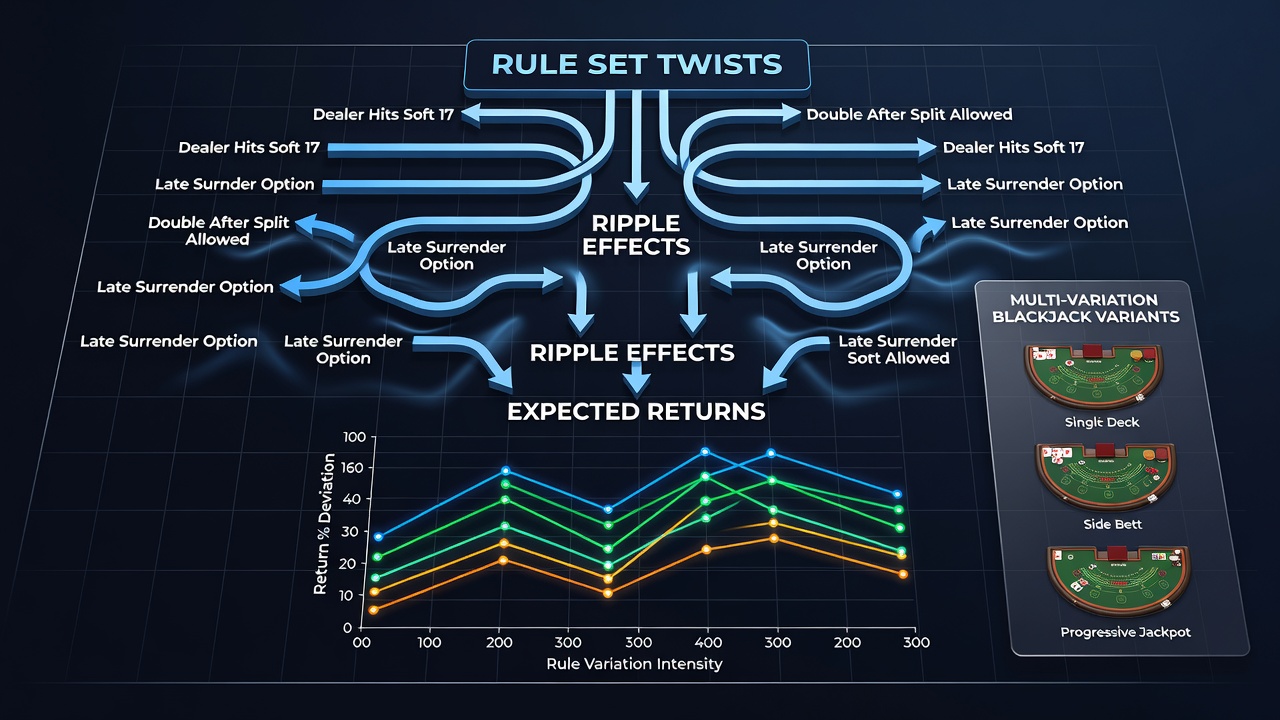
Observers tracking developments through August 2026 note that regulatory updates in several jurisdictions have prompted casinos to introduce hybrid rule sets that combine elements from Spanish 21 and standard blackjack formats and these hybrids create new calculation challenges for expected returns. One study from a Canadian research institution demonstrated that adding a bonus payout for specific hands in a multi-deck environment altered basic strategy recommendations in 12 percent of decision points and shifted overall player returns by 0.4 percent when averaged across all hands. The ripple extends further when players move between tables with differing rules because mental carryover of strategies from one variation to another can introduce errors that compound the mathematical disadvantages already present in the rules themselves.
Practical Navigation Strategies for Players
Those who study these environments recommend maintaining separate strategy references for each rule bundle rather than attempting mental adjustments on the fly and simulation software developed by industry organizations allows users to input specific rule combinations to generate tailored expected return figures. Evidence suggests that even minor oversights such as applying a standard chart to a game with restricted doubling produce return shortfalls that accumulate over extended play periods and reach several percent in total expectation. Regulatory bodies in regions outside the United Kingdom including those in Australia and parts of the United States have published guidelines on rule disclosure that assist players in identifying these variations before committing to play yet the responsibility for accurate calculation remains with the individual.
Additional complexities arise in online platforms where instant switching between game variants occurs and data indicates that players who fail to reset their approach for each new rule set experience measurable declines in long-term returns. Academic papers on probability modeling emphasize the value of pre-session analysis that accounts for all active rules simultaneously rather than sequential evaluation since the order of assessment can mask interaction effects that only become visible in combined modeling.
Conclusion
Rule set twists in multi-variation blackjack settings generate ripple effects that require systematic evaluation to determine accurate impacts on expected returns. Research from diverse sources including university studies and regional gaming authorities continues to refine the models that capture these interactions and players benefit from accessing updated resources that reflect current rule combinations across available formats. The mathematical structure of the game ensures that each adaptation produces measurable consequences that accumulate when multiple variations operate together.